Dear Friends
After a long time I was very busy in my Delcampe Auction Store, I could not update my personal site, Now every thing is OK and I start uploading my stock at my site also. Stamps, Banknotes, Phonecards, Postcards and many other items available at my Delcampe store and my personal site.
Please visit:
http://www.aliphilatelic.com
Delcampe Store No. 1:
http://www.delcampe.net/stores/aliphilatelic
Delcampe Store No. 2:
http://www.delcampe.net/stores/coverclub
Regards
Rizwan Sadiq
Sunday, January 27, 2013


Wednesday, February 1, 2012
Stamp Today: Late Arfa Karim Randhawa Young Microsoft Certified...
Stamp Today: Late Arfa Karim Randhawa Young Microsoft Certified...: Arfa Karim Randhawa (2 February 1995 – 14 January 2012) was a Pakistani student and computer prodigy, who in 2004 at the age of nine yea...
Late Arfa Karim Randhawa Young Microsoft Certified
 Arfa Karim Randhawa (2 February 1995 – 14 January 2012) was a Pakistani student and computer prodigy, who in 2004 at the age of nine years became Microsoft Certified Professional (MCP), the youngest in the world until 2008. She was invited by Bill Gates to visit the Microsoft Headquarters in the USA.[5] A science park in Lahore was named after her, the Arfa Software Technology Park.
Arfa was born to a family from the village of Chak No. 4JB Ram Dewali in Faisalabad, Punjab. After returning to Pakistan from a visit to Microsoft headquarters, Arfa gave numerous television and newspaper interviews. S. Somasegar, the vice president of the Software Development Division, wrote about her in his blog. On 2 August 2005, Arfa Karim was presented the Fatimah Jinnah Gold Medal in the field of Science and Technology by the then Prime Minister of Pakistan Shaukat Aziz on the occasion of 113th birth anniversary of Fatima Jinnah. She also received the Salaam Pakistan Youth Award again in August 2005 from the President of Pakistan. Arfa Karim is also the recipient of the President's Award for Pride of Performance, a civil award usually granted to people who have shown excellence in their respective fields over a long period of time. She is the youngest recipient of this award. In recognition of her achievement Arfa was made brand ambassador for Pakistan Telecommunication Company's 3G Wireless Broadband service named EVO in January 2010.
Arfa Karim has represented Pakistan on various international forums, and was invited by the Pakistan Information Technology Professionals Forum for a stay of two weeks in Dubai. A dinner reception was hosted for her there, which was attended by the dignitaries of Dubai including the Ambassador of Pakistan. During that trip, Arfa was presented with various awards and gifts including a laptop. In November 2006, Arfa attended the Tech-Ed Developers conference themed Get ahead of the game held in Barcelona on an invitation from Microsoft. She was the only Pakistani among over 5000 developers in that conference.
In 2011, at the age of 16, Arfa Karim was studying at the Lahore Grammar School Paragon Campus in her second year of A-levels. On 22 December 2011 she suffered a cardiac arrest after an epileptic seizure that damaged her brain, and was admitted to Lahore's Combined Military Hospital (CMH) in critical condition.
On 9 January 2012, Bill Gates, chairman of Microsoft, contacted Arfa's parents and directed his doctors to adopt "every kind of measure" for her treatment. Gates set up a special panel of international doctors who remained in contact with her local doctors through teleconference. The panel received details about her illness and provided assistance in diagnosis and treatment. Local doctors dismissed the option of moving Arfa to another hospital owing to her being on a ventilator and in critical condition. Members of Arfa's family have lauded Bill Gates for offering to bear her treatment expenses. On 13 January 2012, Arfa Karim started to improve and some parts of her brain showed signs of improvement. Her father, Amjad Karim Randhawa, said Microsoft had raised the possibility of flying Arfa to the US for care.
On 14 January 2012, 16-year-old Arfa Karim died at 9:50 PM (Pakistan Standard Time) at Combined Military Hospital (CMH) Lahore. Her Namaz-e-Janaza was offered in Cavalry Ground Lahore at 10 AM on 15 January 2012, and later at Faisalabad the same day. The funeral was attended by the Chief Minister of Punjab, Shahbaz Sharif. She was buried at her ancestral village Chak No. 4JB Ram Dewali, Faisalabad.
Although she is not with us but she live in our heart always. She was a pride Pakistan.
A commemorative postage stamp honouring the late Arfa Karim Randhawa, who became the world's youngest Microsoft Certified Professional before dying on January 14 at age 16 of complications from an epileptic stroke is being issued on Feb 02. The postage stamp is depicting image of late Arfa and carrying cash value of Rs 08.
Prime Minister Yousuf Raza Gilani on January 20 approved the commemorative stamp to recognise her achievement.
Sunday, September 18, 2011
10 Pakistan Sim Phonecards For Sale

http://phonecards.delcampe.fr/page/item/id,0144261709,language,F.html
Tuesday, August 30, 2011

Saturday, August 13, 2011

Thursday, August 4, 2011
Struggle against AIDS - Stamps from Pakistan and Algeria
 Acquired immune deficiency syndrome or acquired immunodeficiency syndrome (AIDS) is a disease of the human immune system caused by the human immunodeficiency virus (HIV). This condition progressively reduces the effectiveness of the immune system and leaves individuals susceptible to opportunistic infections and tumors. HIV is transmitted through direct contact of a mucous membrane or the bloodstream with a bodily fluid containing HIV, such as blood, semen, vaginal fluid, preseminal fluid, and breast milk. This transmission can involve anal, vaginal or oral sex, blood transfusion, contaminated hypodermic needles, exchange between mother and baby during pregnancy, childbirth, breastfeeding or other exposure to one of the above bodily fluids. AIDS is now a pandemic. As of 2009, the World Health Organization (WHO) estimated that there are 33.3 million people worldwide living with HIV/AIDS, with 2.6 million new HIV infections per year and 1.8 million annual deaths due to AIDS.]In 2007, UNAIDS estimated: 33.2 million people worldwide had AIDS that year; AIDS killed 2.1 million people in the course of that year, including 330,000 children, and 76% of those deaths occurred in sub-Saharan Africa.[8] According to UNAIDS 2009 report, worldwide some 60 million people have been infected, with some 25 million deaths, and 14 million orphaned children in southern Africa alone since the epidemic began.
Genetic res
 earch indicates that HIV originated in west-central Africa during the late nineteenth or early twentieth century. AIDS was first recognized by the U.S. Centers for Disease Control and Prevention in 1981 and its cause, HIV, identified in the early 1980s. Although treatments for AIDS and HIV can slow the course of the disease, there is no known cure or vaccine. Antiretroviral treatment reduces both the mortality and the morbidity of HIV infection, but these drugs are expensive and routine access to antiretroviral medication is not available in all countries.[13] Due to the difficulty in treating HIV infection, preventing infection is a key aim in controlling the AIDS pandemic, with health organizations promoting safe sex and needle-exchange programmes in attempts to slow the spread of the virus.
South Georgia - Frozen Planet Stamp Issue
 This spectacular South Georgia stamp issue, Frozen Planet, released ahead of the BBC's Frozen Planet TV series, is due for release on 15th September 2011.
 The theme of these stamps, like the series they represent, is the extreme seasonality that occurs in the Polar Regions.
Produced by the BBC's Natural History Unit, Frozen Planet is the most ambitious series on the Polar Regions ever undertaken.
For four years, camera teams braved temperatures down to -50 degrees C, 200 mile per hour katabatic winds, midnight sun and long dark polar nights to capture the essence of these remote and highly seasonal ends of the earth.
More than 2300 filming days were spent in the field, by small crews working in the most remote corners of Antarctica and across the Arctic. The aim was to take the viewer on a journey through the Polar Regions - north and south - some of the greatest, least explored wildernesses on the planet.
In the south, one of the key locations was the sub-Antarctic Island of South Georgia. The team undertook 4 major filming trips to document the lives of some remarkable animals whose dramas play out on this remote and spectacular island.
Six different camera teams were deployed to South Georgia over a period of around 3 months, covering stories as varied as the whaling history to Shackleton’s epic walk. By far the most effort, however, was spent documenting the lives of the animals, which visit the island during the different seasons.
The stamps feature:
60p - Southern Elephant Seals
70p - Wandering Albatross
95p - Blonde Fur Seal Pup
£1.15p - King Penguin
£2.50p - souvenir sheet showing a Wandering Albatross in flight against the South Georgia backdrop
Frozen Planet broadcasts on BBC One in autumn 2011. The series is presented by Sir David Attenborough, who himself first visited South Georgia in 1982 while filming for the television series, Living Planet.
US Postage Stamps Feature Matson Container Ships
 The U.S. Postal Service salutes the U.S. Merchant Marine by issuing 60 million Forever stamps in a four-stamp pane which includes a container ship operated by the Matson Navigation Company.
 The four-stamp design on this pane features types of vessels that have formed an important part of merchant marine history: clipper ships, auxiliary steamships, Liberty ships, and container ships.
The Matson ship stamp is based on an undated photograph of the R.J. Pfeiffer, a modern container ship launched in 1992 and operated by Matson Navigation Company.
The U.S. Merchant Marine stamps are being issued as Forever stamps. Forever stamps are always equal in value to the current First-Class Mail one-ounce rate.
Ascension Island - Red-billed Tropicbird WWF Issue

This Ascension Island stamp issue is due for release on 31st August 2011.
All stamps carry the WWF Panda logo and are released in sheets of twenty with gutter and a sheetlet of sixteen (four sets in staggered format). Values are 35p, 40p, 90p and £1. Sheet stamps have a white border whilst those in the sheetlet 'bleed off'.
The three species of tropicbird all have tropical distributions. Two species are found in the tropical Atlantic and both breed on Ascension Island, with the majority of both species breeding on Boatswainbird Island. The most numerous is the Yellow-billed Tropicbird, or Boatswainbird (so called because its call is likened to that of a Bosun's whistle) after which the island was named. About 500 pairs of Red-billed Tropicbirds breed on Ascension.
The Red-billed Tropicbird is a powerful bird around 48cm long (up to 100cm including the central tail feathers) and with a wingspan of 105cm. It is a white bird with black near the wing-tips, fine dark grey barring over the back and with two long trailing tail feathers. The bill is long, strong and red (yellow in juveniles as can be seen on the 90p value) and the legs are yellowish.
At sea the flight is strong and direct, resembling a pigeon, but when seen from land the birds are generally making repeated and hesitant approaches to nest sites.
Courtship flights can also be seen where several birds alternate rapid flapping and dramatic glides, accompanied by chuckles and screams (giving rise to the name Boatswainbird).
Like all tropicbirds they feed on fish and squid by hovering and then plunging vertically into the sea, although they are poor swimmers.
They nest in crevices in the rocks and where these are in short supply fighting, sometimes to the death, is common. The single egg is fawn to rich purple and averages 64 x 45mm. Incubation lasts around 43 days. Both parents incubate and shifts can last several days.
The birds spend the non-breading season far out to sea, undergoing a complete moult before returning to land.
Friday, July 22, 2011
Shah Abdul Latif Bhittai Religious Poet and Musician

Shah Abdul Latif Bhittai (also referred to by the honorifics Lakhino Latif, Latif Ghot, Bhittai, and Bhitt Jo Shah) (1689 – 1752) was a Sindhi Sufi scholar, mystic, saint, poet, and musician. He is widely considered to be one of the greatest poets of the Sindhi language. His collected poems were assembled in the compilation Shah Jo Risalo, which exists in numerous versions and has been translated to English, Urdu, and other languages. His work frequently has been compared to that of Rūmī: Seyyed Hossein Nasr, Professor of Islamic studies at George Washington University, described Shah Latif as a "direct emanation Rūmī's spirituality in the Indian world.
He settled in the town of Bhit Shah in Matiari, Pakistan where his shrine is located. The major themes of his poetry include Unity of God, love for Prophet, religious tolerance and humanistic values.
Shah Abdul Latif Bhittai was born in 1689 in Hala Haveli's village Sui-Qandar located near Hyderabad, Pakistan. Shah Abdul Latif was son of Syed Habibullah and grandson of Syed Abdul Quddus Shah.
According to most scholars, Shah Abdul Latif Bhittai's lineage goes back to the Khwarizim Shahs, others claim he was a descendant of Mohammad and grandson of Mohammad. He however used the term "Shah" as a surname.
His ancestors had come from Herat in Afghanistan to Sindh, after it was sacked by Timur and his Mongol forces. Shah Abdul Karim Bulri (1600s), whose mausoleum stands at Bulri, about 40 miles from Hyderabad, a mystic Sufi poet of considerable repute, was his great, great grandfather. His verses in Sindhi are existent and his anniversary is still held at Bulri, in the form of an Urs.
His father Syed Habib Shah, lived in Hala Haveli, a small village, at a distance of about forty miles from Matiari and not far from the village of Bhitshah. Later he left this place and moved to Kotri, where Shah Latif spent some part of his adolescent life.
Most of the information that has come down to us has been collected from oral traditions. A renowned Pakistani scholar, educationist, and a foremost writer of plays, dramas and stories, Mirza Kalich Beg has rendered a yeoman service to Sindhi literature by collecting details about the early life of Shah Bhittai, from the dialogues that he has constantly held with some of the old folks, still living at that time, who knew these facts from their fathers and grandfathers for they had seen Shah Latif in person and had even spoken to him.
"The next day I sat down, and listened to the Story of the 'Vairagis.' Their salmon-coloured clothes were covered with dust. The lonely ones never talk to anyone about their being. They move about unmarked amongst the common folk." ........Shah Latif Bhittai
He was born around 1689 CE (1102 A.H.) to Shah Habib in the village Sui-Qandar a few miles to the east of the present town of Bhit Shah (named after him), on Safar 14, 1102 A.H. i.e. November 18, 1690 CE. He died at Bhit Shah on Safar 14, 1165 A.H., i.e. January 3, 1752 CE. In his memory, every year, on 14th Safar of the Hijri Calendar, an Urs is held at Bhit Shah, where he spent the last years of his life and where his elaborate and elegant mausoleum stands.
Latif got his early education in the school (maktab) of Akhund Noor Muhammad in basic Persian (the government language at that time) and Sindhi (local spoken language). He also learned the Qur'an. His correspondence in Persian with contemporary scholar Makhdoom Moinuddin Thattvi, as contained in the Risala-i-Owaisi, bears witness to his scholastic competence.
“
"Beloved's separation kills me friends, At His door, many like me, their knees bend. From far and near is heard His beauty's praise, My Beloved's beauty is perfection itself." .....Bhittai [Sur Yaman Kalyan]
Young Shah Abdul was raised during the golden age of sindhi culture. His first teacher was Noor Muhammad Bhatti Waiwal. Mostly, Shah Latif was self-educated. Although he has received scanty formal education, the Risalo gives us an ample proof of the fact that he was well-versed in Arabic and Persian. The Qur'an, the Hadiths, the Masnawi of Maulana Jalaluddin Rumi, Shah Inayatullah, along with the collection of Shah Karim's poems, were his constant companions, copious references of which have been made in Shah Jo Risalo. He is also known for his famed Calligraphic, and hand written skills he made several copies of the Qur'an.
Shah Abdul Latif Bhittai, received his higher education in the Maktab of Akhund Noor Muhammad in basic Persian (the official language of the Mughal Empire) and Sindhi. He is also known to have  memorized vast passages of the Qur'an. His correspondence in Persian with contemporary scholar Makhdoom Moinuddin Thattavi, as contained in the Risala-i-Owaisi, bears witness to his scholastic competence. In his poems he writes about Sindh and its neighbouring regions, he mentions the distant cities such as Istanbul and Samarqand, he also writes about Sindhi sailors (Samundi) their navigation techniques voyages as far to the Malabar coast, Sri Lanka and the island of Java.Shah Abdul Latif Bhittai, mentions his travels in the Risalo.Sindhi historians believe that the Tambura was invented by Shah Abdul Latif Bhittai.
In appearance, Bhittai was a handsome man, of average height. He was strongly built, had black eyes and an intelligent face, with a broad and high forehead. He grew a beard of the size of Muhammad's beard. He had a serious and thoughtful look about himself and spent much time in contemplation and meditation, since he was concerned about his moral and spiritual evolution with the sole purpose of seeking proximity of the Divine. He would often seek solitude and contemplate on the burning questions running through his mind concerning man's spiritual life:
Why was man created?
What is his purpose on this earth? What is his relationship with his Creator?
What is his ultimate destiny?
Although he was born in favoured conditions, being the son of a well-known and very much respected Sayed family, he never used his position in an unworthy manner, nor did he show any liking for the comforts of life. He was kind, compassionate, generous and gentle in his manner of speech and behaviour which won him the veneration of all those who came across him. He had great respect for woman, which, unfortunately, the present day Vaderas (the landlords) do not have, and he exercised immense reserve in dealing with them, in an age when these qualities were rare. He hated cruelty and could never cause physical pain to any man or even to an animal. He lived a very simple life of self-restraint. His food intake was simple and frugal, so was his dressing which was often deep yellow, the colour of the dress of sufis, jogis, and ascetics, stitched with black thread. To this day, his relics are preserved at Bhitsah (where his mausoleum stands), including a "T"-shaped walking stick, two bowls, one made of sandal-wood and another of transparent stone, which he used for eating and drinking. His long cap and his black turban are also preserved.
In quest of religious truths, Shah Abdul Latif Bhittai traveled to many parts of Sindh and also went to the bordering lands as far as Multan. He became well known to the rulers at height of the power and rule of Kalhoras in Sindh. However he independently traveled with Sufi brotherhoods visiting towns and cities, to preach the teachings of Islam. Throughout his travels he went to hills, valleys, riverbanks, fields and mountains where he met the ordinary simple people. He is known to have traveled to the Ganjo Hills in the south of Hyderabad, Sindh.
He also writes about the adventures of Samundis (Sindhi Sailors) and how they voyaged to Lanka and Java, in the Sur Surirag and Sur Samundi, he writes a detailed account on Thatta and the port Debal. He is known to have traveled with Baloch nomads and tribes into the mountains in Las Bela, Balochistan. For three years, he traveled with these jogis and sanyasis, in search of the truth, peace, and harmony. At several places in the Risalo, mention has been made of these jogis and of his visits to these wonderful, holy and peaceful places. He also traveled to such far away places in the Thar desert such as Junagadh, Jaisalmer.
By the time he was a young man of twenty one years, he began to be known for his piety, his ascetic habits and his absorption in prayers. Observation and contemplation were chief traits of his character. A number of people flocked round him adding to the already large number of his disciples. This aroused jealousy of some powerful, ruthless, tyrannical persons - landlords, Pirs, Mirs, and Rulers - who became his enemies for some time. Later, seeing his personal worth, and the peaceful and ascetic nature of his fame, abandoned their rivalry. At this time he was living with his father at Kotri, five miles away from the present site of Bhitshah. It was here that his marriage was solemnised in 1713 CE with Bibi Sayedah Begum, daughter of Mirza Mughul Beg. She was a very virtuous and pious lady, who was a proper companion for him. The disciples had great respect for her. They had no children.
In the true ascetic spirit, Shah Latif was now in search of a place where in solitude, he could devote all his time in prayers and meditation. Such a place he found near Lake Karar, a mere sand hill, but an exotic place of scenic beauty, four miles away from New Hala. This place was covered by thorny bushes surrounded by many pools of water. It was simply and aptly called 'Bhit' (the Sand Hill). On the heaps of its sandstones he decide to settle down and build a village. As it was sandy, he along with his disciples dug out the hard earth from a distance and covered the sand with it to make the ground firm. After months of hard labour, carrying the earth on their heads and shoulders, the place was now fit enough for the construction of an underground room and two other rooms over it, along with a room for his old parents. A mosque was also built and the houses of his disciples properly marked out. In 1742, whilst he was still busy setting up a new village, Bhit, he got the sad news of the death of his dear father.. Soon after this Shah Latif shifted all his family members from Kotri to Bhitsah, as the village now began to be called. His father was buried there, in accordance to his will, where his mausoleum stands only eight paces away, from that of Shah Abdul Latif, towards its north.
For the last eight years of his remarkable life, Shah Latif lived at Bhitshah. A few days before his death, he retired to his underground room and spent all his time in prayers and fasting, eating very little.
“
"Laggi Laggi wa'a-u wiarra angrra latji, Pa-i khanen pasah-a pasan karran-i pirin-a jay." ......Bhittai "Wind blew! The sand enveloped the body, Whatever little life left, is to see the beloved."
”
After 21 days in there, he came out and having bathed himself with a large quantity of water, covered himself with a white sheet and asked his disciples to sing and start the mystic music. This went on for three days continuously, when the musicians, concerned about the motionless poet, found that his soul had already left for its heavenly abode to be in the proximity of the Beloved for who he had longed for, all his life, and only the body was there. He suffered from no sickness or pain of any kind. The date was 14th Safar 1165 Hijra corresponding to 1752 CE. He was buried at the place where his mausoleum now stands, which was built by the ruler of Sindh, Ghulam Shah Kalhoro. His name literally means 'the servant of t he Shah'. He, along with his mother, had adored and revered Shah Latif and were his devoted disciples. The work of the construction of the mausoleum was entrusted to the well-known mason, Idan from Sukkur. The mausoleum, as well as the mosque adjoining it, were later repaired and renovated by another ruler of Sindh, Mir Nasir Khan Talpur. A pair of kettle drums, that are beaten every morning and evening even till today by the fakirs, jogis and sanyasis, who frequent the mausoleum, were presented by the Raja of Jesalmeer.
“
"Korren kan-i salam-u achio a'atand-a unn-a jay." "Countless pay homage and sing peace at his abode."
"Tell me the stories, oh thorn-brush, Of the mighty merchants of the Indus, Of the nights and the days of the prosperous times, Are you in pain now, oh thorn-brush? Because they have departed: In protest, cease to flower. Oh thorn-brush, how old were you When the river was in full flood? Have you seen any way-farers Who could be a match of the Banjaras? True, the river has gone dry, And worthless plants have begun to flourish on the brink, The elite merchants are on decline, And the tax collectors have disappeared, The river is littered with mud And the banks grow only straws The river has lost its old strength, You big fish, you did not return When the water had its flow Now it's too late, You will soon be caught For fishermen have blocked up all the ways. The white flake on the water: Its days are on the wane." ......Bhittai [translated by Prof. D. H. Butani (1913-1989) in The Melody and Philosophy of Shah Latif
”
According to Sindhi historians young scholars such as Abul Hassan Thattvi (author of the Muqadamah as-Salawat, Hanafi Compendium) also wrote and sought advise from the elderly Shah Abdul Latif Bhittai and frequently traveled to Bhit Shah.
The women of Shah Abdul Latif's poetry are known as the Seven Queens, heroines of Sindhi folklore who have been given the status of royalty in Shah Jo Risalo. The Seven Queens were celebrated throughout Sindh for their positive qualities: their honesty, integrity, piety and loyalty. They were also valued for their bravery and their willingness to risk their lives in the name of love. The Seven Queens mentioned in Shah Jo Risalo are Marvi, Momal, Sassi, Noori, Sohni, Sorath, and Lila.
These tragic romantic tales are Momal Rano, Umar Marvi, Sohni Mahiwal, LiLa Chanesar, Noori Jam Tamachi, Sassi Punnun and Dhaj, Ror Kumar or Seven Queens (Sindhi: ست مورميون) of Shah Abdul Latif Bhittai. Heer Ranjha and Mirza Sahiba, including Sohni Mahiwal and Sassi Punnun are the four other tales from Punjab, narrated in Punjabi by various other Sufi poets like Waris Shah. Sassi Punnun and Sohni Mahiwal are culturally included in both Punjabi and Sindhi traditions. These nine tragic romances from South Asia (all from now days Pakistan)have become part of the cultural identity of Pakistan.
Perhaps what Shah Abdul Latif Bhittai saw in his tales of these women was an idealized view of womanhood, but the truth remains that the Seven Queens inspired women all over Sindh to have the courage to choose love and freedom over tyranny and oppression. The lines from the Risalo describing their trials are sung at Sufi shrines all over Sindh, and especially at the urs of Shah Abdul Latif every year at Bhit Shah.
Stamp Today: 100th Birth Anniversary Celebration 2011of His Hol...
Stamp Today: 100th Birth Anniversary Celebration 2011of His Hol...: "His Holiness Dr. Syedna Muhammed Burhanuddin Abul-Qaid Johar born Marc h 6, 1915 is the 52nd Dai or Unrestricted Missionary of the..."
Tuesday, July 19, 2011
100th Birth Anniversary Celebration 2011of His Holiness Dr. Syedna Muhammad Burhanuddin Saheb (TUS)


His Holiness Dr. Syedna Muhammed Burhanuddin Abul-Qaid Johar born March 6, 1915 is the 52nd Dai or Unrestricted Missionary of the Dawoodi Bohras. The Dawoodi Bohras are a sub group within the Mustaali, Ismaili Shia branch of Islam.
Burhanuddin was born in Surat, Gujarat, India. He was appointed to be the future Dai at the age of 19 by his father, the previous Dai Taher Saifuddin. Burhanuddin succeeded his father, upon the latter's death when he was 53 years of age. He has seven sons and three daughters and all members of his family reside at Saifee Mahal, Mumbai.
Burhanuddin completed recitation of the Quran in 1921. At around the age of 13 he escaped an accident when bridge railing collapsed while on travel in Colombo, where his vehicle got hung on one wheel. He got lakab of Burhanuddin at age of 15 on his occasion of misaq. He received the designation of hadiyath (Sheikh) from 51st Dai at the age of 17 (1931 A.D.) and later designated as mazoon at the age of 20. He became hafiz at age of 21 (1935 A.D.) and married Amatullah Aai two years later.
Much later (1381 AH) he made a trip to Yemen to visit the earlier Dais of Yemen and consequently received the designation of "Mansural-Yaman". At the age of 53 (1965 A.D.) he became 52nd Dai on death of his father Taher Saifuddin.
Burhanuddin organised Ashura (Imam Husain's) function at various locations and addressed the gathering of Dawoodi Bohra (invited from all over world).
The
community held a ceremony at the Taheri Masjid Complex to mark the occasion. It began with a welcome address by Mullah Hasnain.Shaikh Shabbir Bhai Sadriwala informed the audience about the genesis of the idea of coming up with a postage stamp to commemorate the centennial birth celebrations of the Syedna, and thanked the government and the Pakistan Post for extending their support in this regard.
He also talked about those, including stamp collector M. Arif Balagamwala, who floated the idea of issuing a commemorative stamp at an expo held in January this year and also designed the stamp.
After that Mullah Hasnain gave the background to the design of the stamp. He said it had the image of Baab-i-Hatimi at Aljameatus Saifiya, North Nazimabad, which actually represented the 1000-year-old architectural design from the Fatimid period in Egypt.
Honorary secretary of the Faiz-i-Hakimi Saifuddin Bhai said that Syedna Burhanuddin had many qualities (he’s a teacher, an intellectual, a researcher, a guide, a spiritual leader etc), and had always taught and preached about the welfare of mankind. He said one of the essential teachings of the Syedna to his followers was serve and be loyal to the country where they lived. He also praised the Burhani Guards Trust (BGT) for its extensive and untiring efforts in arranging the programme and undertaking other assignments.
M Arif Balagamwala said that the ceremony was one of its kind because it was taking place on a Sunday. He said 500,000 stamps had been printed since the government didn’t allow more than that number, so it would be good if they were bought as early as possible.
BGT chairman Mr Noorudddin told the audience that the stamps would be showcased in a museum in Mumbai as well.
He said that throughout the history of Pakistan, leaders from the Quaid-i-Azam to the present prime minister had treated the Dawoodi Bohra community with affection.
For any purchase of stamps or FDCs please contact via E.Mail: aliphilatelic@gmail.com
(Thanks Dawn News and Wikipedia)
Friday, July 15, 2011
Penny Black 1840
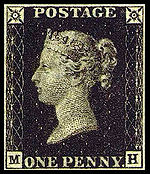
The Penny Black was the world's first adhesive postage stamp used in a public postal system. It was issued by the United Kingdom of Great Britain and Ireland on 1 May 1840, for official use from 6 May of that year.
All London post offices received official issues of the new stamps but other offices throughout the United Kingdom did not, continuing to accept postage payments in cash only for a period. Post offices such as those in Bath, began offering the stamp unofficially after 2 May.
The idea of an adhesive stamp to indicate pre-payment of postage was part of Sir Rowland Hill's 1837 proposals to reform the British postal system; it was normal then for the recipient to pay postage on delivery. A companion idea, which Hill disclosed on 13 February 1837 at a government enquiry, was that of a separate sheet that folded to form an enclosure or envelope for carrying letters. At that time postage was charged by the sheet and on the distance travelled.
Postal delivery systems using what may have been adhesive stamps existed before the Penny Black. Apparently the idea had at least been suggested earlier in Austria, Sweden, and possibly Greece.
Hill was given a two-year contract to run the new system, and together with Henry Cole he ran a competition to identify the best way to pre-pay letters. None of the 2,600 entries were good enough, so Hill launched the service in 1840 with an envelope bearing a reproduction of a design created by the artist William Mulready and a stamp bearing a representation of the profile of the reigning British monarch, Queen Victoria. There are also references on the record to covers bearing the Mulready design. All British stamps still bear a picture or silhouette of the monarch somewhere on the design, and are the only postage stamps in the world that do not name their country of origin, leaving the monarch's image to symbolise the United Kingdom.
In 1839, the British Treasury announced a competition to design the new stamps, but none of the submissions was considered suitable. The Treasury chose a rough design endorsed by Rowland Hill, featuring an easily recognisable profile of 15-year-old former Princess Victoria. Hill believed this would be difficult to forge. The head was engraved by Charles and Fredrick Heath based on a sketch provided by Henry Corbould. Corbould's sketch was based on the cameo-like head by William Wyon, which had been designed for a medal used to commemorate the visit of Queen Victoria to the City of London in 1837.[2][3] The word "POSTAGE" appeared at the top of the stamp (revenue stamps had long been used in the UK) and "ONE PENNY." at the bottom, indicating the amount that had been pre-paid for the transmission of the letter to which it was affixed. The background consisted of finely engraved engine turnings. The two upper corners contained star-like designs and the lower corners contained letters designating the position of the stamp in the printed sheet; "A A" for the stamp at the top left, and "T L" for the bottom right. The sheets, printed by Perkins Bacon, consisted of 240 stamps in 20 rows and 12 columns. As the name suggests, the stamp was printed in black ink.
Although 6 May was the official date that the labels became available, there are covers postmarked 2 May, due to postmasters selling the stamps from 1 May. A single example is known on cover dated 1 May 1840.
The Penny Black was in use for only a little over a year. It was found that a red cancellation was hard to see on a black background and the red ink was easy to remove, making it possible to re-use stamps after they had been cancelled. In 1841, the Treasury switched to the Penny Red and issued cancellation devices with black ink, much more effective as a cancellation and harder to remove. However, the re-use of stamps with the un-cancelled portions of two stamps to form an unused whole impression continued, and in 1864 the stars in the top corne rs were replaced by the check letters as they appeared in the lower corners, but in reverse order.
When sheets of the Penny Black were first printed various postal and other officials took the liberty of removing various numbers of stamps from their sheets to present as gifts to dignitaries and other important people. These sheet portions are commonly referred to by collectors as "imprimaturs" or "imprimatur sheets". There are approximately 850 of these sheet portions in the British Postal Museum which also include overprints for British Bechuanaland, Oil Rivers, Levant and Zululand and also departmental overprints such as Army and Inland Revenue.
The Penny Black was printed from 11 plates, but as plate 1 was completely overhauled due to excessive wear, it is generally considered to be two separate plates, 1a and 1b. Plate 11 was originally intended solely for the printing of new red stamps, but a small number were printed in black. These are scarce.
The stamps were printed in unperforated sheets, to be cut with scissors for sale and use.
An original printing press for the Penny Black, the D cylinder press invented by Jacob Perkins and patented in 1819, is on display at the British Library in London.
The Penny Black is not a rare stamp. The total print run was 286,700 sheets with 68,808,000 stamps and a substantial number of these have survived, largely because envelopes were not normally used: letters in the form of letter sheets were folded and sealed, with the stamp and the address on the obverse. If the letter was kept, the stamp survived. However, the only known complete sheets of the Penny Black are owned by the British Postal Museum.
The Penny Black is readily available on the collectors' market; a used stamp in poor condition can cost as little as £100 ($200); in 2011, a used stamp in fine condition cost about £1100, an unused example about £1,800, with prices steadily rising. By contrast, a used Penny Red was £0.50.
In addition to the general issue of the Penny Black, a similar stamp was produced with the letters V and R in the top corners replacing the stars, intended for official mail. Following the general public's acceptance of the postage stamps and the ridicule of the Mulready stationery produced at the same time, vast supplies of the letter sheets were given to government departments, such as the tax office, for official use and the idea of introducing an official stamp was abandoned. Only a few postally used examples exist, which probably originated from the Post Office circulars sent out as advance notice that the new stamps would be brought into use. Four are known on covers; all were cut from their envelopes and then replaced. Most of the cancelled examples are from trials which were made of cancellation types, inks, and experiments with their removal. These trials led to the change from black to red stamps, and vice versa for the cancellations.
The VR official is stated to have been made from the original master die. However, this cannot be the case as this die still exists with the original stars intact, in The British Postal Museum & Archive in London. It is believed that the master for this stamp was produced from the transfer roller used for the production of plate 1 with the stars removed from the top corners, as some impressions show traces of these original stars.
Monday, December 7, 2009
Stamp Collecting
 The starting point for many new collectors, is to ask family and friends to save stamps from their incoming mail. Although the stamps received by major businesses, and those kept by elderly relatives, may be of international and historical interest, the stamps received from family members are often of the definitive sort. Definitives seem mundane but, considering their variety of colours, watermarks, paper differences, perforations and printing errors, they can fill many pages in a collection. Introducing either variety or specific focus to a collection can require the purchasing of stamps, either from a dealer or online. Large numbers of relatively recent stamps, often still attached to fragments or envelopes, may be obtained cheaply and easily. Rare and old stamps can also be easily obtained from similar sources, with costs extending far beyond the means of all but a tiny minority of collectors.
Duplicate stamps are the stamps that a collector already has, and are therefore not required to fill a gap in a collection. Duplicate stamps can be sold or traded, so they are an important medium of exchange among collectors.
Many stamp dealers now sell their merchandise over the Internet, while others still have neighborhood stamp shops, which are one of the best resources for beginning and intermediate collectors. Some dealers also jointly set up week-end stamp markets called "Bourses" that move around a region from week to week. They also meet collectors at regional exhibitions and stamp shows.
[edit] Collecting specialties
A complete worldwide collection would be enormous, running to thousands of volumes, and incredibly expensive to acquire; many consider that Count Ferrary's collection at the beginning of the 20th century was the most complete ever formed. So many collectors limit their scope, such as to particular countries, time periods, depicted subjects (called "topicals") or types of stamps.
Some of the more popular collecting areas include:
Postage stamps - particular countries and/or time periods
Definitive stamps - the most common type of stamps
Commemorative stamps - stamps to commemorate events, anniversaries etc., on sale for a limited time. Commemorative stamps are available at a stamp dealer.
Pictorials - stamps printed with images of a country's scenery or lifestyle.
Revenue stamps - stamps issued to pay tax in small amounts. Some early stamps had Postage and Revenue printed on them, to indicate that they were acceptable for both uses.
Postal stationery - includes government-issued postal cards, aerograms, letter card, newspaper wrappers, envelopes etc. Interestingly, the earliest postal stationery predates the earliest stamps- the Kingdom of Sardinia issued the first postal letter sheets in 1819 while New South Wales issued the first postal stationery envelope in 1838.
Sheets
Sheetlets - this is a format that is now issued regularly by postal administrations. Instead of issuing stamps in large sheets of 40 or more stamps, smaller sheetlets with 16 or 20 stamps are issued with a large selvage area which may incorporate part of the stamp design or theme.
Miniature sheet - is very similar to Souvenir sheet, it will be in a form of a sheetlet with a single or a number of stamps embedded in it.
Souvenir sheets - the many postal services sometimes release stamps in a format that look like a sheet with a big picture. Various parts of the picture can be torn out and used as postage stamps. See example with 10 stamps in one picture. (Souvenir sheets should be distinguished from souvenir cards, which are souvenirs of a philatelic meeting or exhibition but are not valid for postage.)
Corner blocks or plate blocks - compose a block of stamps from one of the four corners of the stamp sheet. Collectors usually opt for a block of four stamps, complete with the selvage area which will sometimes have the printing details on it.
Airmail stamps - stamps required for airmail, which was typically more expensive and had special postage rates.
Postage due stamps are special stamp applied by a post office to mail bearing insufficient postage. The stamps were issued in several denominations to make up different amounts due.
Federal Duck Stamps (stamps for duck hunting licenses, mainly U.S. with some other countries such as Canada and New Zealand)
First day covers - (FDCs) - envelopes with stamps attached and canceled on the first day that the stamp was issued. Most modern FDCs bear designs, called "cachets" related to the theme of the stamp issued.
PHQ Cards, these cards are pictorial postcards, issued by the British Post Office Royal Mail, each card shows an enlarged colour reproduction of a commemorative stamp.
First Day Ceremony Programs - these are folders or brochures given out to attendees of the First Day Ceremonies of postage stamps, with historical information on the stamp, a list of speakers, and an attached stamp, canceled on the First Day of Issue. Collectors of "FDCPs" generally prefer their programs autographed by those who spoke at the ceremony.
souvenir pages - with first day cancelled stamps on a page describing all design, printing and issuing details. This is similar to first day covers except that it is done on a printed sheet of paper instead of an envelope, and the specification of the stamp is printed by the official source. See picture of first souvenir page in the US.
Topical - many collectors choose to organize their philatelic collection on the theme of the stamps, covers, or postmarks. Popular topical themes are animals, dogs, cats, butterflies, birds, flowers, art, sports, Olympics, maps, Disney, scouting, space, ships, Americana (topics relating to the US), stamps on stamps, famous people, chess, Chinese new year, and many others.
Philatelic literature
Cinderellas - stamp-like labels that are not valid for postage
Government issued material associated with postage stamps (e.g., envelopes)
stamp-like labels
non-stamp items picturing actual postage stamps
non-stamp items picturing stamp-like labels
counterfeit/forged postage stamps (Before purchasing a rare and valuable stamp for which there is any doubt as to authenticity, it is always advisable to obtain an expert's certificate stating that the stamp is authentic. The most prominent stamp expertising organizations in the U.S. are the Philatelic Foundation and the American Philatelic Society.) There are several types of collectible faked postage stamps:
postal counterfeits are produced by criminals for fraudulent use as postage stamps; frequently, these are scarcer than the stamps which they were intended to represent in part because counterfeits are subject to government seizure and selling them may be illegal
forgeries of rare stamps
reprints are produced by government printing offices or private organizations using the plates used to produce the original stamps; stamp catalogues often contain information on how to distinguish reprints from the originals
faked stamps are common stamps which have been altered to resemble rare stamps; examples of such "fakery" include forged overprints, forged cancellations, chemical alterations of a stamp's color, added perforations.
postmarks or postal markings in general
stampless covers - not all postal markings are associated with postage stamps. Prior to the issuance of postage stamps, postmarks were applied to letters at the location where they entered the mails. The markings were either in manuscript or, at larger post offices, were made with handstamps. Many of these handstamps resemble those in use today (a circle containing the location and date of posting). Typically, the amount of postage was written in the upper right hand corner of the letter or package and the word "Paid" added to the amount if the postage was prepaid. However, a majority of letters and packages were sent without prepayment and the recipient was expected to pay the amount written on the letter or package.
Friday, December 4, 2009
Hungary Issued M/Sheet In Memoriam of Michael Jackson
 This souvenir sheet was released in Hungary on a special day, Michael Jackson's birthday. It was designed by graphic artist Janos Girgasz using an artistic photograph by Eszter Gordon, and was printed by Allami Nyomda Nyrt.
The sheet shows a scene from the Budapest concert with Michael Jackson in the perforated section.
A total of 5,000 copies of the souvenir sheet were made in perforated and imperforated colour, and in perforated and imperforated black proof versions.
The souvenir sheet and souvenir sheet packages are available from Magyar Posta's Philately Centre.
Sunday, November 29, 2009
2009 Hong Kong - Brazil Football Joint Issue
 Hongkong Post Issued a set of stamps based on the theme of "Football Hong Kong, China - Brazil Joint Issue". Football has long been recognised and accepted as a universal sport. It is a popular pastime for people from all walks of life in Hong Kong as well as a source of national pride and passion in Brazil. Therefore decided to capture the worldwide enthusiasm for soccer in a special stamp issue in collaboration with Brazil Post - the 10th event of this nature undertaken b
 y Hongkong Post. Official first day covers priced at $1 each put on sale at all post offices while stamps and associated philatelic products will go on display at the General Post Office, Tsim Sha Tsui Post Office, Tsuen Wan Post Office and Sha Tin Central Post Office from the same day.
Hongkong Post has also produced a Prestige Gift Set featuring a 24K gold plated football mounted on a black wood base attached with stamps housed in a matted black box decorated with a gold foiled and embossed icon.With traditional elegance and modern design, the Prestige Gift Set is an ideal collection item for philately lovers and soccer fans. Information about this special stamp issue and associated philatelic products may be obtained from the website of Hongkong Post at (http://www.hongkongpost.com/.
Austria Issued M/Sheet on 200th Anniversary of the Birth of Charles Darwin
 Charles Darwin is known for his position that he took on evolution. He believed that evolution occurred and that the evolutionary changes took place over millions of years. He also believed in a process called "natural selection" which is one of the current concepts of modern biology. His final theory about evolution is that all species came from a single life form. His beliefs in evolution contradicted many religious beliefs then, and still do today.
Thursday, November 26, 2009
Wednesday, November 25, 2009


Subscribe to:
Posts (Atom)